Renewable Energy Hubs: From strategic direction to practical implementation in Viet Nam
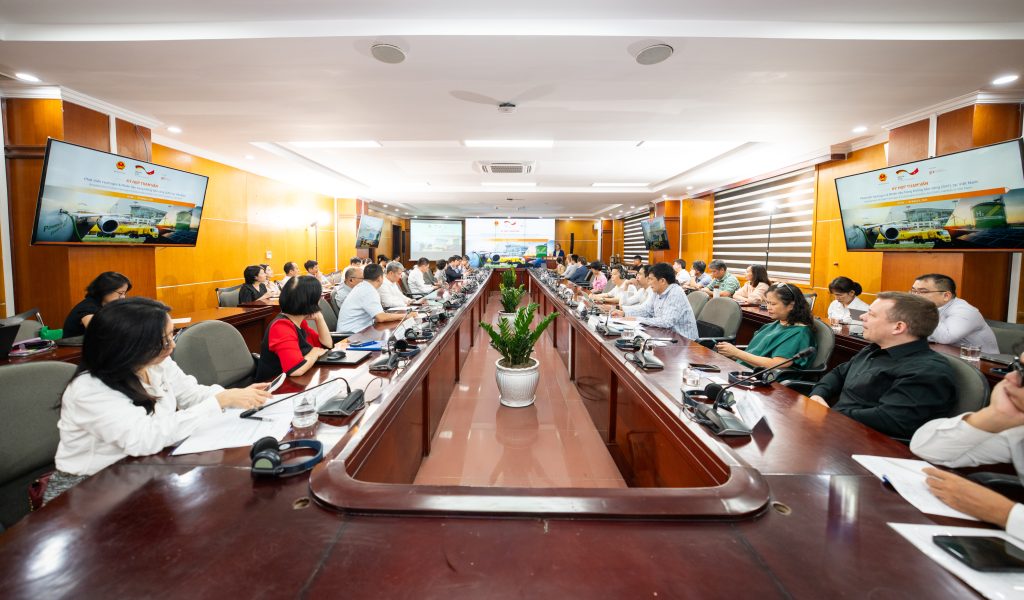
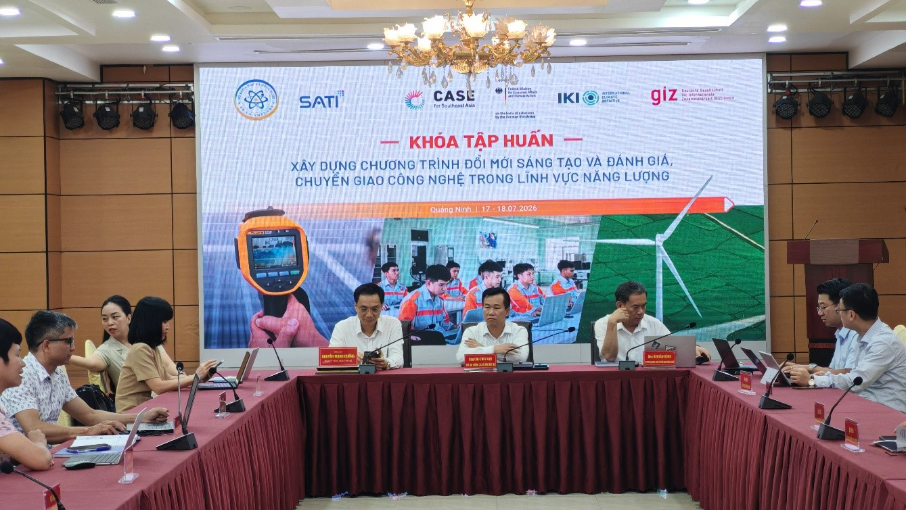
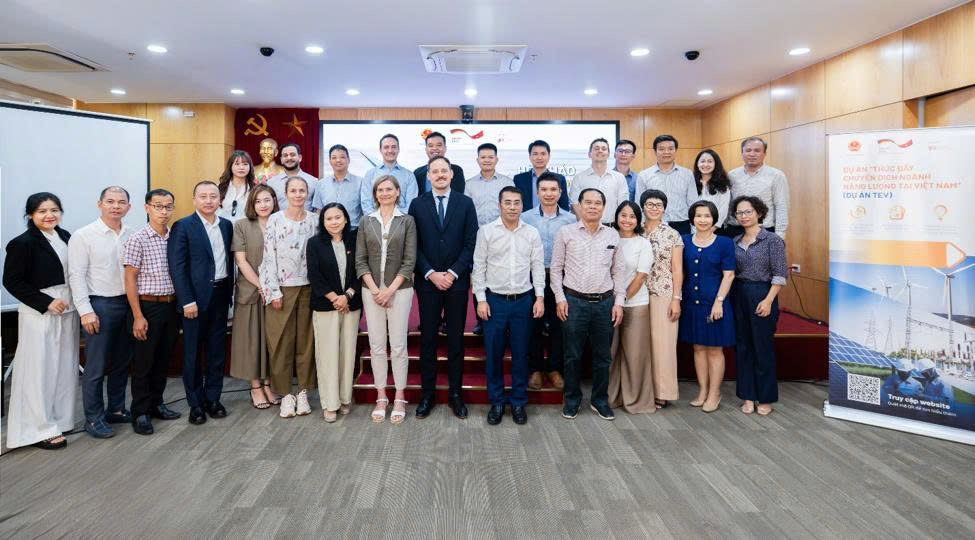
Hanoi, 08 September 2026 – The Electricity Authority of Viet Nam (EAV), Ministry of Industry and Trade (MOIT), in cooperation with the Deutsche Gesellschaft für Internationale Zusammenarbeit (GIZ), organized the workshop “Promoting the development of Renewable Energy Hubs in Viet Nam”, under the framework of the Promoting the Transition of the Energy Sector in Viet Nam (TEV) project, commissioned by the German Government.
The workshop builds on ongoing research and discussions on the Renewable Energy Hub (RE Hub) model in Viet Nam. A conceptual study completed in July 2025 initially proposed RE Hubs as integrated ecosystems combining renewable energy development, manufacturing, infrastructure and supporting services, research & innovation, and human resource development. Building on this foundation, further studies are being conducted to assess the conditions and potential for developing this model, particularly in the Center and the South of Viet Nam.
The workshop aimed to move discussions from strategic orientations and conceptual approaches towards the practical aspects of implementation, through the sharing of international experience and discussions among government agencies, experts, businesses, investors and other stakeholders. Key topics included the model and criteria for site selection; infrastructure and port development; governance and investment mechanisms; supply chain development and localization; operations and maintenance (O&M) and human resources; as well as the conditions required to develop RE Hubs that are appropriate to Viet Nam’s context.
The workshop’s discussions and exchange of experience will contribute practical inputs to the ongoing studies, help identify opportunities, challenges and necessary conditions, and support the proposal for appropriate next steps in developing RE Hubs in Viet Nam.
Participants included representatives from EAV, GIZ, government agencies and organizations in the energy sector, international organizations and development partners; as well as domestic and international experts, businesses and investors active in renewable energy, offshore wind, industry and supply chains.
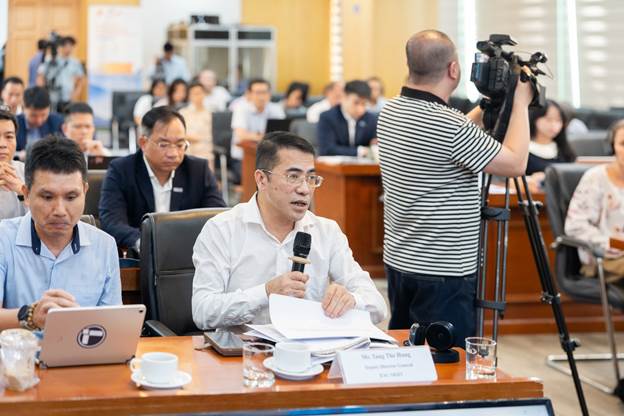
In his opening remarks, Mr. Tang The Hung, Deputy Director General of EAV, emphasized that, as Viet Nam accelerates its energy transition and pursues the goal of achieving Net-zero emissions by 2050, renewable energy development is increasingly linked to the need for coordinated development of industry, infrastructure, supply chains, science and technology, and human resources. The revised Power Development Plan VIII identifies the development of inter-regional renewable energy industrial and service centers in areas with significant renewable energy potential as one of the directions for linking renewable energy development with industrial development and the localization of value chains. Against this background, research into and the gradual development of RE Hubs are important for harnessing Viet Nam’s renewable energy potential, promoting industrial development, and contributing to the country’s energy transition.
The workshop brought together domestic and international experts with practical experience in renewable energy, offshore wind, port infrastructure, industry and supply chains. Speakers from Viet Nam, Germany, China, the United Kingdom and Denmark presented different perspectives on the establishment and development of RE Hubs, industrial clusters and related services.
From Viet Nam, representatives of the Vietnam Petroleum Institute (VPI), Petrovietnam, shared perspectives on the strategic role of RE Hubs, factors to be considered in site selection, and the potential for developing the offshore wind value chain. The presentation highlighted that Viet Nam already possesses important foundational capabilities from the oil and gas and maritime industries, including steel structure fabrication, offshore engineering, ports, logistics and technical human resources. At the same time, it identified capabilities that still need to be further developed to gradually establish a domestic offshore wind ecosystem.
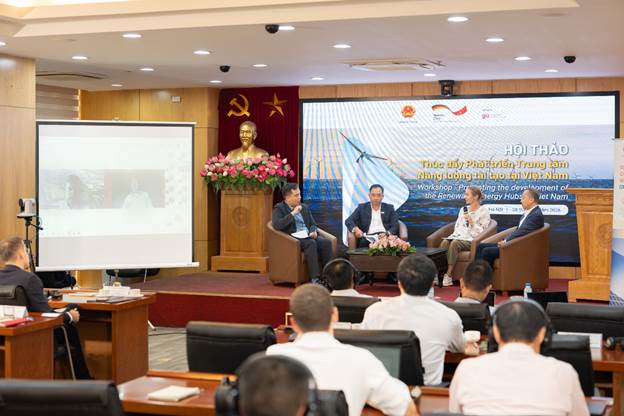
International experts presented four practical cases, each reflecting a different approach. The experience of Cuxhaven, Germany, highlights the importance of long-term investment and coordinated development of ports, industrial land and dedicated logistics infrastructure. The cases of Yangjiang and Shantou, China, demonstrate the development of large-scale industrial clusters integrating manufacturing, R&D, testing and certification, ports, O&M and workforce training. Meanwhile, Grimsby and Humber in the United Kingdom highlight the long-term economic value generated by operations and maintenance activities, particularly in terms of job creation, skills development and the local economy. The experience of Esbjerg, Denmark, demonstrates how existing port and industrial capabilities, including those developed through the oil and gas sector, can be transformed to support offshore wind, while emphasizing the importance of a long-term vision and coordination among the public sector, port authorities and businesses.
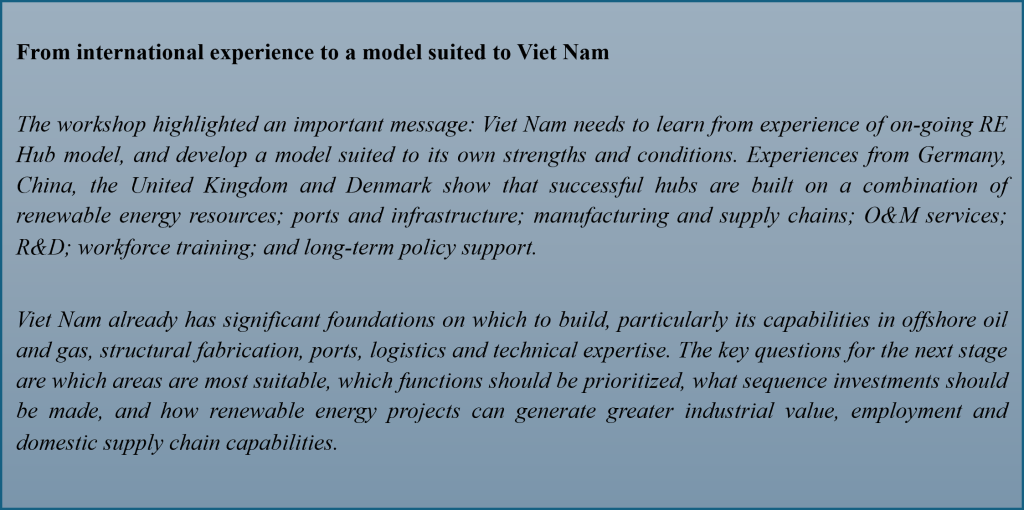
The experiences shared at the workshop demonstrate that there is no single RE Hub model that can be applied universally. The value of international cases for Viet Nam lies in identifying the factors behind the success of each model and assessing how these lessons can be adapted to domestic conditions. The discussions therefore provide additional practical inputs for research on site selection, infrastructure, development models, supply chains, human resources and investment mobilization for Renewable Energy Hubs in Viet Nam.
Discussions at the workshop focused on practical issues such as the selection of models and locations; identification of priority functions; development of ports, infrastructure and logistics; investment mobilization; development of domestic supply chains and manufacturing capabilities; as well as workforce preparation and the policy conditions required. Viet Nam’s existing capabilities in offshore oil and gas, manufacturing, ports and technical services were recognized as important foundations that can be further leveraged and developed to enable deeper participation in the offshore wind value chain.
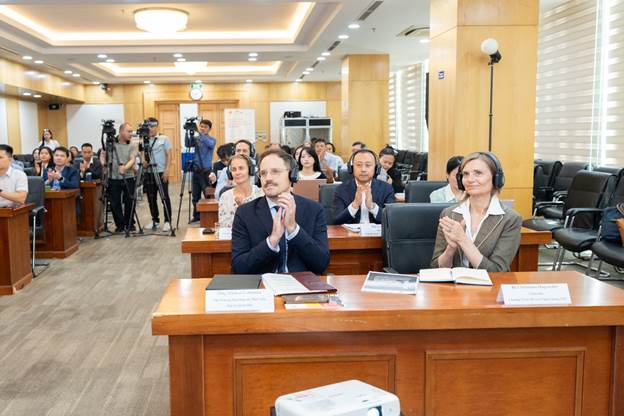
Ms. Christiana Hageneder, Director of GIZ’s Energy Support Programme, shared that GIZ is working with EAV to undertake a study aimed at providing a stronger and more comparable evidence base to support decision-making in the period ahead. The study is expected to assess existing capabilities and conditions, infrastructure gaps, as well as the legal and financial requirements necessary for implementation. According to her, RE Hubs can play an important role in helping Viet Nam strengthen its domestic industrial base, create long-term value from the energy transition, and enhance the competitiveness and position of Vietnamese companies in regional renewable energy supply chains.
The workshop represents a continuation of research and dialogue on RE Hubs in Viet Nam, while helping to move discussions from concepts and strategic orientations towards more concrete implementation issues. The international experiences, insights from Viet Nam’s own context, and exchanges among stakeholders at the workshop will serve as useful references for further studies on the models, locations, infrastructure, supply chains and conditions required for the development of RE Hubs in Viet Nam.
Through this process, the development of RE Hubs is expected not only to support the effective utilization of Viet Nam’s renewable energy potential, but also to create momentum for industrial and service-sector development, strengthen domestic supply chain capabilities, develop human resources, and generate additional economic value for local communities, thereby contributing to Viet Nam’s energy transition.